How to Play Springle Puzzle
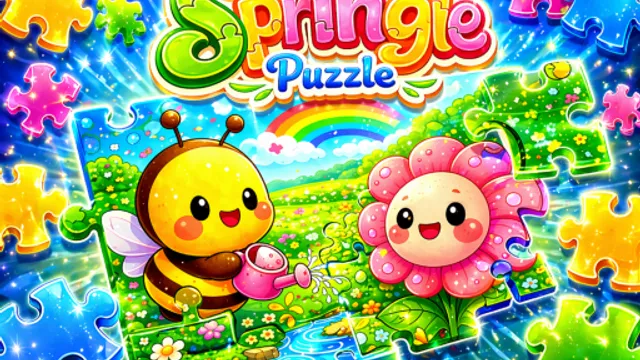
Springle Puzzle is a jigsaw with a stopwatch attached. Pieces arrive scattered, you drag them around with the mouse or a touchpad, and when two neighbors line up they lock together. Keep joining until the picture is whole. Before you start you get two choices that shape the entire run: the cut style — Classic, Irregular, Hexagon, or Wave — and the piece count, 16 for a quick game or 32 for a bigger challenge and a higher score. If the timer runs low, watching a reward ad tops it back up so a good board doesn’t have to end early.
The cut style matters more than it looks. Classic gives you the familiar tab-and-slot edges you can read at a glance, while Irregular and Wave produce silhouettes that fight your instincts about which piece goes where. Hexagon changes the geometry outright — six sides means six possible neighbors, so the usual “find the corner, build the frame” opening doesn’t apply the same way. At 32 pieces the timer stops being generous, and that’s where the game gets interesting: you have to stop hunting for individual pieces and start sorting by color and edge type, because scanning the whole tray for every single placement is what burns the clock.
Tips for Beating the Clock
- Sort before you solve. Spend your first few seconds pushing pieces into rough color groups. Every later placement then searches a small pile instead of the entire board, and that compounds fast.
- Build outward from what already fits. Two joined pieces give you a much longer, more distinctive edge to match against than a lone piece does. Growing one cluster beats starting five.
- Take 16 pieces to learn a cut style, 32 to score. Run an unfamiliar style like Wave or Hexagon at the small size first so you learn how its edges read, then switch up for the points.
- Follow the lines in the picture. A road, a horizon, or a strong color boundary crosses several pieces at once. Chasing those continuous features finds neighbors faster than staring at piece shapes.
Frequently Asked Questions
Is Springle Puzzle free to play?
Yes. It’s free in the browser, and extra time is available by watching a reward ad rather than paying.
Which puzzle style should I pick first?
Classic. Its edges behave the way you expect a jigsaw to behave, which makes it the cleanest place to get a feel for the timer before trying Irregular, Hexagon, or Wave.
Does it work on a phone or tablet?
Yes — the whole game is dragging pieces, which translates directly to touch. A bigger screen does make 32-piece boards easier to read.